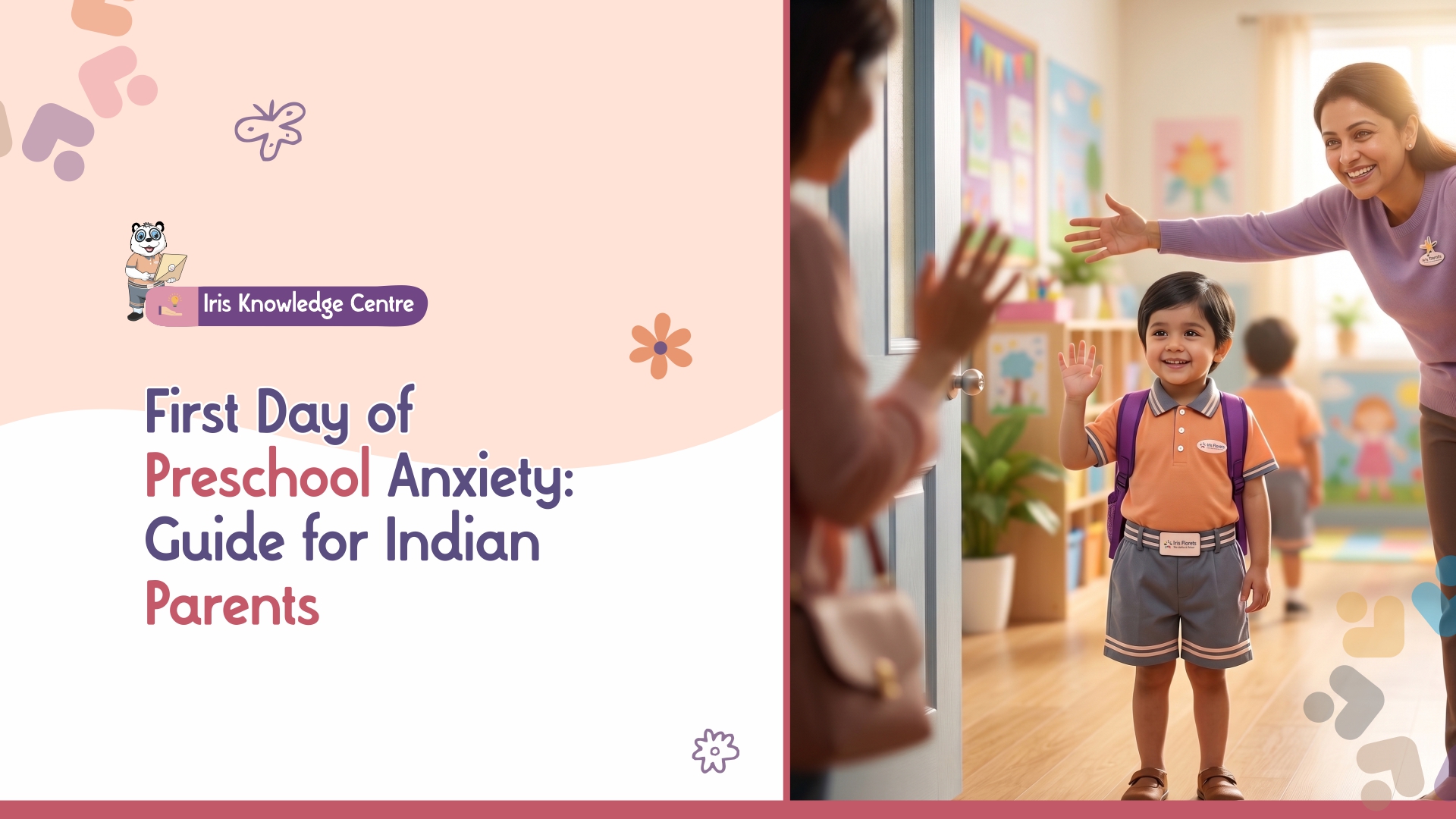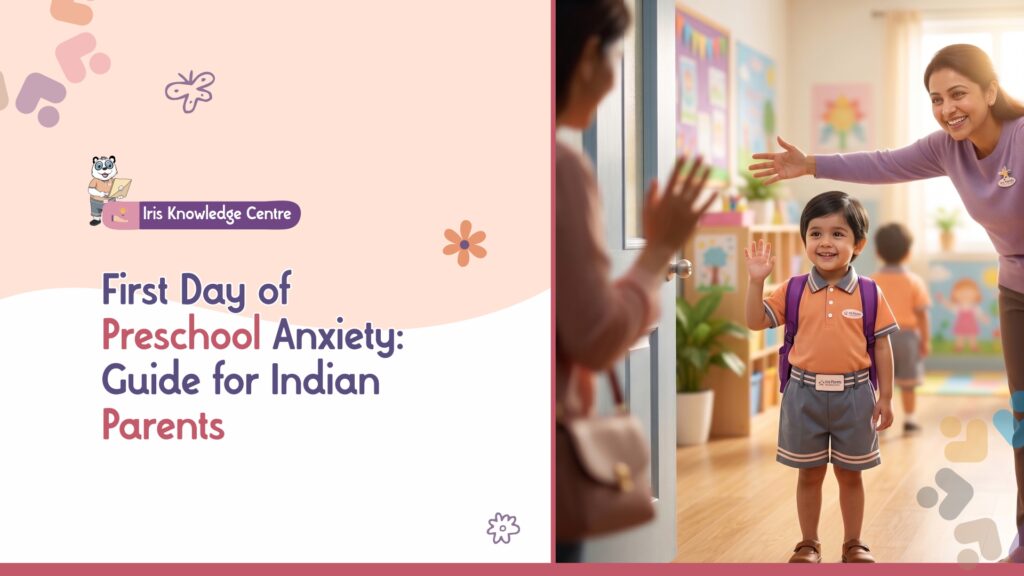
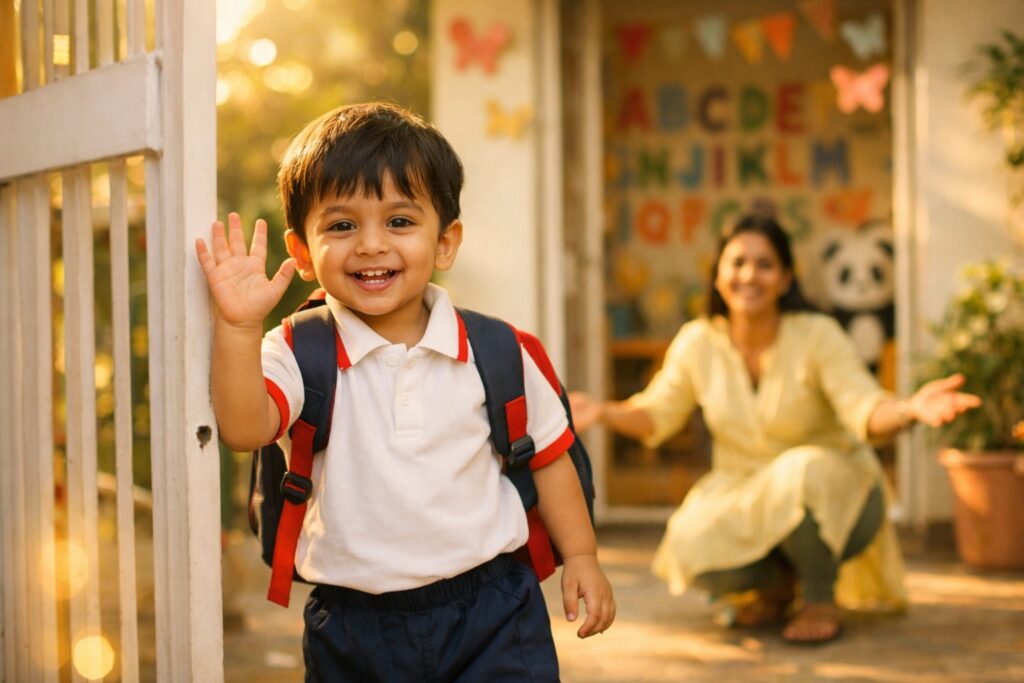
The morning your two-year-old stands at the school gate with huge eyes and a wobbling lip is, for most families, the first real goodbye of their life. Until this moment, a trusted adult — Ma, Dadi, Nani, the ayah — has almost never been out of arm’s reach. So when the school bag is zipped, the water bottle filled and the tiffin packed, and your child suddenly flings both arms around your neck and refuses to let go, know this: your child is not being difficult. Their brain is doing exactly what an attached, healthy brain is built to do.
The good news is that separation anxiety follows a remarkably predictable arc, and two or three weeks of thoughtful handling almost always resolves it. This guide distils decades of global child-development research alongside the realities of Indian mornings — entourage drop-offs, tearful grandmothers included — into a calm, practical playbook.
What’s really happening in your child’s brain
Between 8 and 14 months, babies develop what developmental science calls object permanence — the understanding that things exist even when they can’t be seen. That’s a beautiful milestone, but it’s also the moment separation anxiety begins. The child now understands that when you leave the room, you still exist somewhere else — and that is terrifying. Anxiety typically peaks around 18 months, softens before age 2, and then reappears predictably at preschool entry, usually between ages 2.5 and 4.
Classical attachment research has shown for decades that protest at separation is a sign of secure attachment, not weakness. A child who cries at drop-off is a child who knows they are loved. The toddler stage of autonomy also runs in parallel: the same toddler who shouts “I do it myself!” when you try to help with shoes can, minutes later, cling to your dupatta at the school gate. Both are normal.
By age three, most children understand the effect their pleas have on adults. They are not manipulating you — but they are communicating, with every tool they have, that this transition feels big.
Why preschoolers often feel it more intensely
In most of our homes, a child has rarely been fully alone with a stranger. Dadi, Nani, Mumma, Papa, an ayah, the domestic help who has known them since birth — a dense network of familiar adults cushions every hour of their day. Preschool is not just a separation — it is often a first-ever separation. That is why the children can take slightly longer to settle than Western textbook timelines assume.
Compound this with three cultural amplifiers. First, multi-generational drop-offs — parents, grandparents and sometimes an uncle converge at the gate, and the goodbye stretches to fifteen emotional minutes. Second, adult anxiety is contagious: if Dadi is dabbing her eyes, the child immediately reads danger. Third, cultural discomfort with visible crying produces bribes, lies, or worse — the cancelling of school for “just today.”
Developmental psychology research has consistently linked dependency-oriented parenting patterns to higher child separation anxiety — a pattern culturally amplified in interdependent Indian households.
Is this normal, or should I worry?
Typical adjustment timeline:
- Days 1–7: The most intense crying, clinging, morning tummy aches.
- Week 2: Often a regression after the first weekend — this surprises many parents but is completely normal.
- Weeks 3–6: Steady settling. By the end of week 6, the vast majority of neurotypical children walk in willingly.
Normal signs: Tears that stop within 5–20 minutes after drop-off, clinginess at the morning routine, one or two clingy mornings a week, mild sleep disruption in the first week.
Signs to discuss with a paediatrician or child psychologist: Panic attacks, persistent vomiting before school, self-harming behaviours (hair-pulling, hitting self), sleep disturbance beyond four weeks, regression of toilet training or speech lasting more than three weeks, or complete refusal to engage at school after six weeks. A small percentage of children have clinical separation anxiety that responds very well to professional support — early consultation is always worth it.
8 evidence-based strategies that actually work
1. Run a two-week “preschool rehearsal”
Don’t wait for Day 1. Two weeks before school starts, move bedtime and wake-up to school timings. Pack and unpack the actual school bag together. Have “tiffin time” at 10:30 am. Practise the uniform. Walk or drive the route. The nervous system calms when the unknown becomes familiar.
2. Visit the classroom — with photos
Ask the school for a short visit. Photograph the gate, the teacher, the classroom, the toilet. Back home, create a tiny “my school book” and read it every night. Pre-visits are consistently rated by early-childhood educators as one of the single most effective separation-anxiety interventions.
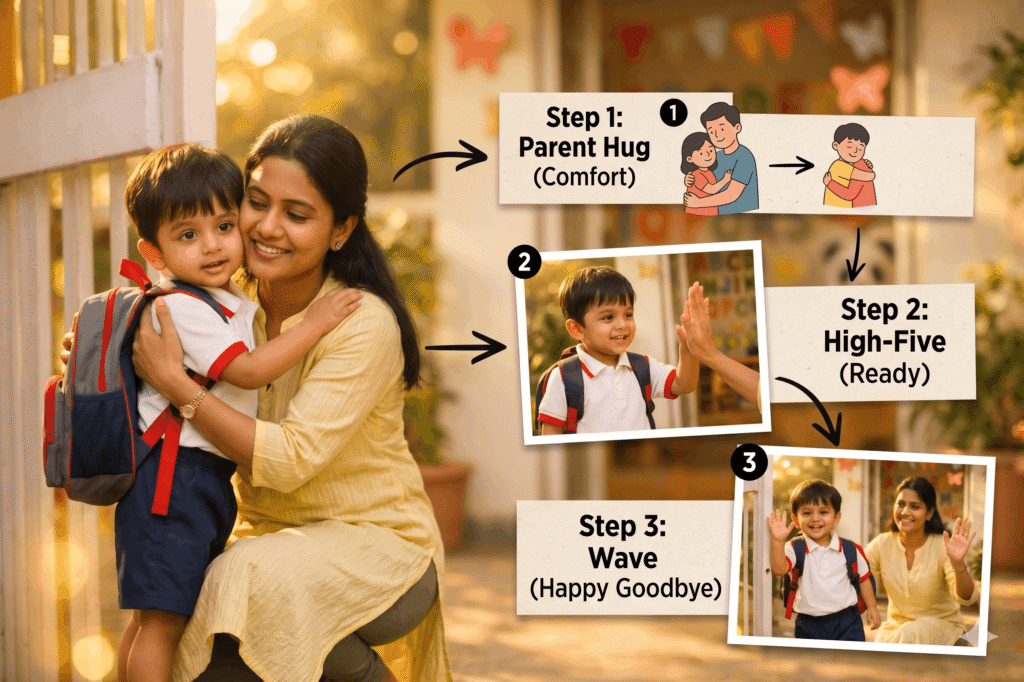
3. Design a 30-second goodbye ritual
The research is unambiguous: don’t leave without saying goodbye — sneaking away makes a child worry you might disappear at any time. But a long goodbye is equally harmful. Design a predictable, 30-second ritual — the same hug, the same words (“Mumma will come after lunch-nap”), the same wave from the same spot. Brief, warm, and exactly the same every single morning.
4. Pack a transition object
A laminated family photo in the bag, a small handkerchief with Mumma’s perfume, a soft toy — something the teacher can quietly place in your child’s hands during a tough moment. For Indian children this can be culturally rich: Nani’s bangle in a pouch, a tiny Ganesha sticker, a rakhi.
5. Use child-friendly time markers
Never say “in three hours.” Say “after lunch and nap time, Mumma will come.” Young children don’t understand clocks; they understand routine. Tie your return to something concrete in their day.
6. Never sneak, never bribe, never compare
These three back-fire without exception. Sneaking shatters trust. Bribes (“I’ll buy ice cream if you don’t cry”) turn every morning into a negotiation. Comparisons (“Look how Aarav is so brave”) wound long after the tears dry.
7. Partner with your child’s teacher
Send the teacher a one-page note: nickname, favourite songs in your mother tongue, comfort style (hug vs. hair-stroke), food quirks, sleep and toilet routine. Agree on one daily WhatsApp photo so you feel reassured without disrupting the classroom. Teachers trained in early childhood — like those in Iris Florets’ 1:10 classrooms — use techniques like assigning the anxious child a small “classroom job” (handing out crayons, helping with the morning greeting), which converts fear into purpose.
8. Regulate your own feelings first
Children mirror the adult nervous system. If one parent or grandparent cannot manage a dry-eyed goodbye, have someone else do drop-off for the first two weeks. This is not coldness — it is emotional leadership.
Six things to never do, however tempting
- Threaten the school itself (“If you don’t behave, school mein bhej denge”) — it primes dread.
- Linger and repeatedly return after saying goodbye — it doubles the distress.
- Lie about timing — “five minutes” that turns into four hours destroys trust.
- Skip school after one bad day — it teaches escalation works.
- Discuss your own anxieties in front of the child on the drive there.
- Compare with cousins or classmates — it teaches shame, not bravery.
 Connection, consistency and calm — the three anchors
Across every credible global and Indian framework on early-years emotional wellbeing, three words recur: connection, consistency, and calm. When your child goes through the emotional difficulty of starting school, the school and the parents need to come together to support her, rather than blame her or each other. Separation protest is a sign of secure attachment, not a character flaw — and the parent’s calm is the child’s first medicine.
The view from Iris Florets
At Iris Florets, we have watched tens of thousands of first-day goodbyes across 150+ centres. The pattern is nearly universal: the children who settle fastest are the ones whose parents follow a calm, boundaried, well-rehearsed ritual. Our teachers are trained to create a “home away from home” — familiar songs in regional languages, transition corners with comfort cushions, and Iro the Happy Panda greeting every little learner at the door. A 1:10 teacher-child ratio means every anxious moment is met by a warm hand.
You are not sending your child away. You are widening their world. And a week from now, when they run in without a backward glance, you will know you got this right.