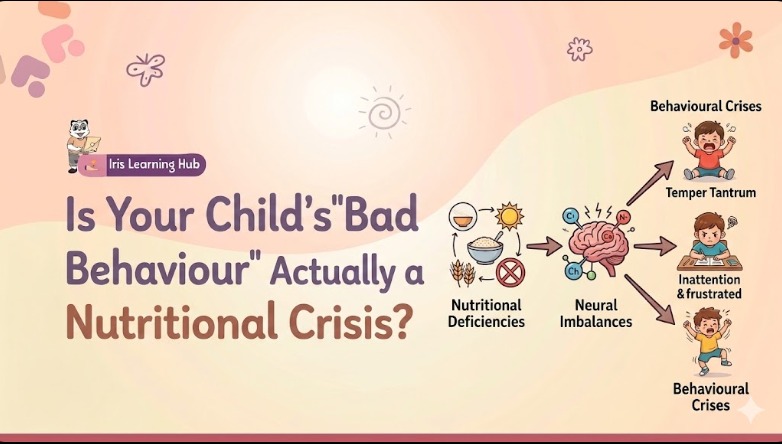
Before you count to ten, take away screen time, or wonder where you went wrong as a parent, check what your child ate in the last 24 hours. The answer might change everything.
The brain-nutrition connection — why it matters more in young children than adults
The adult brain makes up roughly 2% of body weight but consumes about 20% of the body’s energy. In a young child, the brain’s energy demand is even more disproportionate — a toddler’s brain uses approximately 43% of the body’s resting metabolic rate. It is the most energy-hungry organ in the body, and it is also the most dependent on specific micronutrients to function properly. When those nutrients are missing — even temporarily, even for a single day — the first system to show the strain is not the immune system or the digestive system. It is the behaviour regulation system."A child who cannot regulate their behaviour may not need more discipline. They may need more iron."
“A child who cannot regulate their behaviour may not need more discipline. They may need more iron.”
67%
40%
3×
The behaviours that are most commonly misread
WHAT PARENTS SEE
Explosive tantrums in the late morning, approximately 90 minutes after a light breakfast
WHAT MAY BE HAPPENING
Blood sugar crash following a high-carbohydrate, low-protein breakfast — the brain signals distress through behaviour before hunger is consciously felt
WHAT PARENTS SEE
Inability to sit still, listen, or follow two-step instructions during learning time
WHAT MAY BE HAPPENING
Iron or zinc deficiency impairing dopamine pathways — the child genuinely cannot sustain attention, not a behaviour choice
WHAT PARENTS SEE
Aggression, hitting, or biting — particularly in the afternoonWHAT MAY BE HAPPENING
Dehydration combined with fatigue — the emotional regulation system is severely compromised; even minor frustrations become unmanageable
WHAT PARENTS SEE
Extreme emotional sensitivity — crying at things that would not normally upset themWHAT MAY BE HAPPENING
Omega-3 deficiency affecting serotonin regulation — emotional resilience is partially a nutritional function, not only a developmental one
The four nutrients most directly linked to behaviour in young children
You do not need to become a nutritionist. You need to know which four nutrients are doing the heaviest lifting in your child’s brain — and where to find them.
| Nutrient | What it does to behaviour | Signs of deficiency | Best Indian food sources |
|---|---|---|---|
| Iron Most deficient in India | Powers dopamine production — drives attention, impulse control, emotional regulation | Short attention span, irritability, poor memory, fatigue presenting as hyperactivity | Rajma, chana, spinach, ragi, jaggery, eggs — pair with Vitamin C to improve absorption |
| Zinc Commonly low | Supports neurotransmitter function and stress response regulation | Aggression, social withdrawal, slow learning, frequent illness | Dals, pumpkin seeds, sesame, whole grains, meat, dairy |
| Omega-3 Commonly low | Builds brain cell membranes — directly affects mood stability and emotional resilience | Emotional volatility, poor sleep, difficulty with transitions and change | Walnuts, flaxseed, chia seeds, fatty fish, fortified eggs |
| Protein Most impactful short-term | Provides amino acids for serotonin and dopamine synthesis — directly stabilizes energy and focus | Post-meal mood crashes, inability to self-soothe, chronically low physical energy | Eggs, dal, paneer, curd, moong, groundnuts — at every meal, not just dinner |
The single most actionable change most Indian families can make is adding protein to breakfast. A breakfast of plain roti or white rice with nothing else produces a blood sugar spike followed by a crash. The crash arrives, reliably, 60 to 90 minutes later – and it arrives in the emotional regulation system before the child is consciously hungry. This is why so many difficult school-morning behaviours happen between 9 am and 10:30 am.
What to do this week — a practical reset
Do not overhaul everything at once. That never sustains. Pick the one change below that feels most relevant to what you are observing in your child — and hold it consistently for two weeks before evaluating.
- Add protein to breakfast. Eggs, curd, moong chilla, paneer paratha — anything that provides amino acids alongside carbohydrates. Do this for seven days and note whether the late-morning meltdown window changes.
- Replace the afternoon packaged snack. Biscuits, chips, and packaged snacks are almost nutritionally empty for the brain. Replace with a handful of groundnuts, a small bowl of curd, or fruit with peanut butter. The blood sugar stability improvement is usually noticeable within a week.
- Add one iron-rich food to the daily routine. Ragi porridge at breakfast, rajma once during the week, or spinach incorporated into a familiar dish. Pair it with something containing Vitamin C — tomato, lemon, amla — to double iron absorption.
- Track water intake honestly. >Most parents dramatically overestimate how much water their child drinks. A 4-year-old needs approximately 1.2 to 1.5 litres across the day. Mild dehydration produces no visible thirst signal in young children. They simply become more difficult.
- Get a basic blood panel done. If you suspect iron or zinc deficiency based on what you have read here, a simple CBC and serum ferritin test through your paediatrician will confirm or rule it out. Do not supplement without testing — iron supplementation without deficiency causes its own problems.
|
An important note: nutritional changes take time to show results in behaviour. Iron levels take 4 to 6 weeks of consistent dietary change to meaningfully improve. Omega-3 benefits on mood stability may take 6 to 8 weeks. The behaviours most responsive to quick change are those linked to blood sugar — those can shift within days of improving breakfast and snack quality. Set realistic expectations and measure over weeks, not days |
When nutrition is not the answer
This post is not a claim that all difficult behaviour is nutritional. It is not. Children are complex. Behaviour is shaped by temperament, environment, sleep, emotional experiences, developmental stage, and yes – nutrition. All of these interact.
If your child’s behaviour is severely disruptive, escalating over weeks rather than days, and not responding to any change in routine, nutrition, or environment, that warrants a conversation with your paediatrician and possibly a developmental specialist. Nutritional optimisation is a powerful tool. It is not a substitute for professional assessment when one is needed.
What it is a substitute for is the default assumption that a child who is struggling behaviourally is simply badly behaved, poorly parented, or wilfully difficult. That assumption is rarely true. And it causes enormous, unnecessary guilt in parents who are already doing their best.
FAQ's